

This article was read at the Joint East Asian Studies (JEAS) Conference 2016, 7th-9th September 2016, SOAS, London.
Abstract
German missionary Ernst Johannes Eitel (1838-1908) is an important scholar in the history of Hakka studies. His “Ethnographical Sketches of the Hakka Chinese” (1867-1869) and “An Outline History of the Hakkas” (1873) laid the foundation to develop Hakka identity in the early twentieth century, and Eitel’s methodology was also adopted by later scholars in their Hakka studies. In this paper, I start with reviewing his educational and evangelical backgrounds from archive materials kept in SOAS and Tübingen University to find what influenced him in writing history and ethnography. Then I analyze the etymological clarification of Eitel’s terminology, “ethnographic sketches”, and trace its scholarly root to the mid-eighteenth century Germany. I further make a comparison among Eitel’s works, the German Ethnographie/Völkerkunde tradition, and the British questionnaire of ethnological inquiry. The result reveals Eitel was strongly influenced by his native German tradition. Finally, I find the historical criticism of the Tübingen School, from which Eitel was nourished, was unable to help Eitel critically read the fictitious parts in Hakka genealogies and made him ironically constructed the myth of Hakka migration.
Keywords: Ernst Johannes Eitel (1838-1908), history of Hakka studies, history of ethnography, Hakka customs, construction Hakka migration history
Introduction
Missionaries are forerunners of ethnography, the science of human culture. Although the description of human culture can be traced to ancient times or even earlier, the emergence of ethnography—the modern science of human culture—originated in late-eighteenth-century Germany. It was known in German as Ethnographie (ethnography) or Völkerkunde (knowledge of peoples). August von Schlözer, professor of Göttingen University, is responsible for the coinage of the term Ethnographie and the methodology of this new science.[1] However, Schlözer did not go into the field himself but utilized the data of his former employer Gerhard Friedrich Müller, who traveled in Siberia for ten years as a part of the Second Kamchatka Expedition. Müller studied the history, geography, and ethnography of Siberian peoples and eventually systemized the topics of ethnographic observation during the expedition. Müller did not start the study from scratch. Two decades before Müller’s journey in Siberia, German and Swedish Pietists helped provide for Swedish prisoners of war in Tobolsk, Siberia’s capital, and studied the surrounding regions in their spare time.[2] Their works became the foundation of Müller’s studies, and later of Schlözer’s. In this lineage of modern ethnography, missionaries, as learned clergy, preceded secular scholars in studying non-European peoples and laid the foundation of ethnography. The role of missionaries in ethnography became more significant in the nineteenth century. In 1852, the British Association for the Advancement of Science (BAAS) published a new questionnaire, titled “A Manual of Ethnological Inquiry (MEI)” for describing foreign cultures.[3] It quickly spread throughout the missionary network. Only four years after its publication, Richard Cull, the honorary secretary to the Ethnological Society of London, claimed the new questionnaire had been distributed to nearly all missionary stations worldwide.[4] It was expected that missionaries’ answers would facilitate the science of human culture, which Cull called ethnology. Ethnography and ethnology both study human culture, though there are subtle differences between them.
Calling on missionaries to answer the ethnographic questionnaire is similar to deploying intelligence agents and having case officers gather their findings. In this model, missionaries are gatherers of facts rather than developers of science. However, missionaries in the Hakka country, mostly situated in China’s Guangdong Province, not only studied the Hakka culture and shared their findings with Western academia, but also initiated the construction of Hakka ethnicity and identity in China by describing Hakka culture. Thus missionary ethnography in the late nineteenth century became the backbone of Hakka studies in the following decades. Among the writings of missionaries on the Hakka, Ernst Johannes Eitel’s Hakka ethnography and history are particularly important. Eitel was not the first to write about the Hakka, but his studies have had a significant influence on native scholars, especially Lo Hsiang-lin 羅香林, a vanguard of Hakka studies and promoter of Hakka identity in the twentieth century. Interestingly, even though Eitel wrote in English and served in the London Missionary Society (LMS), his intellectual background was not British but German. This background made Eitel’s works an important bridge between German ethnography and Hakka studies. Moreover, Eitel’s Hakka studies also typified missionary ethnography by relating his ethnography to evangelical objectives. Therefore, studying Eitel’s Hakka ethnography will not only clarify the beginning of Hakka studies and deconstruct the “sacred” Hakka ethnicity; it will also reveal the characteristics of missionary ethnography.
Missionary Ethnography
Before we examine Eitel’s Hakka studies further, it would be worthwhile to define “missionary ethnography.” Missionary ethnography is analogous to missionary linguistics, a recently established subject that studies the linguistic research and documentation conducted by missionaries, especially Christian ones.[5] Thus, as the term suggests, missionary ethnography is missionaries’ description of people. However, this definition only partially resembles missionary linguistics. Religion is an intrinsic part of missionary linguistics.[6] Missionaries study a foreign language in order to preach in that language; this objective is practical and not scholarly. Therefore, in order to be an ethnographic counterpart of missionary linguistics, missionary ethnography must also be related to evangelical purposes. By this narrower definition, some missionaries’ ethnographic studies must be excluded. One example is the ethnography of Fuzhou by Justus Doolittle, who preached there for fourteen years and published Social Life of the Chinese in 1865 after he returned to the United States.[7] Doolittle keenly observed and recorded the customs and beliefs of the people he encountered, offering a valuable glimpse of mid-nineteenth-century Fuzhou. However, Doolittle did not connect his ethnography to his primary duty, evangelism, and thus his ethnography is no different from other learned people’s ethnographic accounts. On the Catholic side, the Jesuits had been studying and writing about Chinese culture since the seventeen century. Their Chinese ethnography was intended to persuade Europeans that Chinese culture had common ground with Christianity and that emphasizing this common ground would help convert the Chinese and gain supports in Europe. Although this idea eventually failed, Jesuit reports on Chinese culture are the forerunners of missionary ethnography in China.
Let us return to Eitel in the 1860s. It is notable that Eitel and his colleagues had great interest in ethnography. He was a major contributor of Notes and Queries on China and Japan, a short-lived journal published between 1868 and 1871. This journal provided a platform for learned Westerners to share their studies on East Asia and to exchange questions and answers. Eitel also published his “Ethnographical Sketches of the Hakka Chinese” in this journal. In 1866, the next year that Eitel offered service to the LMS, John Chalmers, who endorsed Eitel’s application to join the LMS, published a pamphlet on Chinese ethnology.[8] Although Chalmers’s analysis of Chinese script to reveal Chinese ethnology seems odd today, this pamphlet demonstrates the China-based missionaries’ enthusiastic interest in Chinese culture. James Legge, another endorser of Eitel in 1865 and later the first professor of Chinese at Cambridge University, also studied Chinese culture by translating Chinese classics into English. James Legge was a typical Sinologist who started his Chinese study as a missionary. Eitel may also be considered a Sinologist, for his broad studies cover not only vernacular culture but also Chinese Buddhism, which earned him a doctoral degree from Tübingen University, his alma mater.[9] In the following sections, we will further investigate Eitel’s inheritance of German Ethnographie and the influences of his missionary ethnography.
Eitel’s Career
Ernst Johannes Eitel (sometimes Anglicized as “Ernest John Eitel”) was born in Esslingen am Neckar, a former free imperial city in central Württemburg in southwestern Germany. In 1856, at the age of eighteen, he began to study at Tübingen University. Eitel was enrolled in the philosophical faculty in the first year, and he transferred to the Protestant theological faculty to complete his bachelor’s degree in 1860. Eitel’s academic record in these four years is extant in the university archive.[10] The record shows Eitel’s academic training in his young adulthood. He took physical anthropology and psychology; both were social sciences that were still new in the nineteenth century. He also spent three semesters studying Arabic. In theology, Eitel’s major, he was most influenced by Ferdinand Christian Baur, the leader of the Tübingen School of theology. The Tübingen School was shaped by the Late Enlightenment in Germany, which emphasized using historical materials and reading the Bible with historical criticism.[11] The emphasis on history was reflected in Eitel’s record. He spent five semesters taking Baur’s courses “Church History,” “Dogmatic History,” and “Newest Church History,” and he must therefore have been familiar with Baur’s historical criticism in biblical studies. In fact, the intellectual root of the Tübingen School may be traced to eighteenth-century theologian Johann David Michaelis from Göttingen. The influence from Michaelis is particularly interesting. Michaelis had organized a scholarly expedition to Arabia to collect manuscripts for his biblical studies. The Danish court sponsored this expedition and sent scholars to Arabia in 1761, but only Carsten Niebuhr, the cartographer of the expedition, returned from this ill-fated journey.[12] Michaelis was not satisfied with the expedition because the results hardly helped his biblical studies, but this expedition still suggested the methodology of studying the Bible through the ethnographic study of the contemporary Middle East. Considering this influence, Eitel’s endeavor to study Arabic was not simply driven by interest in an exotic culture; it could have been connected to the historical criticism of the Bible. Although he had no opportunity to carry out biblical studies during his career, philological comparisons, the utilization of ethnography, and an emphasis on historical materials would play essential roles in his studies of the Hakka.
After his university education, Eitel became the pastor of Mössingen, a town south of Tübingen, but he did not hold the pastorate for a long time. In 1861, Eitel joined the Basel Mission to become a missionary, and he arrived in Hong Kong the next year. Eitel was deployed to the missionary station at Lilong 李朗, a rural village in today’s Shenzhen City, which is ten kilometers from the New Territory and about thirty-five kilometers from Kowloon. The Basel Mission started its missionary work in China in the 1850s, and Lilong was one of the first missionary stations built by Basler missionaries. From late 1862 to 1865, Eitel worked at Liong with Phillip Winnes, one of the pioneer Basler missionaries. Eitel also learned the Hakka language during this time. When Winnes returned to Europe in 1865 due to illness, Eitel remained and worked alone.[13] However, Eitel’s engagement to Mary Ann Winifred Eaton, the superintendent of the Diocesan Native Female Training School in Hong Kong, forced him to leave the Basel Mission in 1865. Eitel planned to marry Eaton and submitted an application to Basel. However, Eitel did not obtain consent from his brethren in China before applying because, according to Legge and Chalmers’s letter, he assumed that his brethren would not want a member of theirs to marry an Englishwoman and that the Mission would give more freedom to missionaries who completed training before joining the Mission. Unfortunately, Eitel was wrong. The committee in Basel rejected Eitel’s application and ordered him to end his relationship with Eaton. However, their relationship became public before the order arrived. To avoid staining his honor, Eitel resigned from the Basel Mission. As soon as Eitel terminated his connection with the Basel Mission, he sought James Legge and John Chalmers for service in the British mission. Legge and Chalmers endorsed Eitel’s application and recommended that he minister the Hakka-speaking churches of the Poklo District.[14] Eitel was in charge of Poklo until his resignation from the LMS in 1879. In the second half of the 1870s, Eitel changed careers. In 1875, Eitel was appointed director of Chinese studies by Governor Arthur Edward Kennedy to examine the Chinese competence of British employees. The next governor, John Pope Hennessy, appointed Eitel to several positions as an interpreter and as the governor’s secretary of Chinese. In 1879, Eitel resigned from the LMS to focus on service in the Hong Kong government. However, Eitel’s role in an 1879 scandal involving the governor ruined his prospects in the colonial government. Thereafter, Eitel served as inspector of schools until his retirement in 1898.
Although Eitel’s civil-service career failed, he became renowned for his academic activities. Eitel was the editor of Notes and Queries on China and Japan and the China Review. The subtitle of the latter, “Or Notes & Queries on the Far East,” suggests it was a successor of the short-lived Notes and Queries on China and Japan. Both journals were platforms for publishing Westerners’ Oriental studies in the late nineteenth century. Eitel also contributed to both journals. He published his Hakka ethnography in Notes and Queries on China and Japan and his treatise on the Hakka migration history in the China Review. Eitel’s monograph on the history of Hong Kong, Europe in China: The History of Hongkong from the Beginning to the Year 1882,[15] was also published as a series in the China Review. In addition to his editorial work, Eitel studied Chinese Buddhism and published the Hand-book of Chinese Buddhism, a Sanskrit-Chinese encyclopedia of Buddhism concepts.[16] This handbook earned him a doctoral degree from Tübingen University in 1870.[17] Eitel was also a linguist and compiled a Cantonese dictionary, published in 1877.[18] These academic activities built Eitel’s reputation in Sinology, and “Dr. Eitel” became a famous name among missionaries and civil servants in the late nineteenth century. After his retirement from the Hong Kong government in 1898, Eitel and his family moved to Adelaide, Australia. He died in 1908.
Eitel’s German Heritage of Ethnography
Published in Notes and Queries on China and Japan as a series from Vol. 1, No. 5 (May 1867) to Vol. 3, No. 1 (January 1869), “Ethnographical Sketches of the Hakka Chinese” is Eitel’s first major work in the missionary field. In the journal, this work was considered “notes,” meaning that it was longer than a newspaper column but shorter than a monograph. It is also obvious that Eitel did not have a clear writing plan when he published the first article, for the length of each article was not balanced (See Table 1). Article I and II cover one topic each, but Article III and IV cover the same topic, “Characters, Customs, and Manners of the Hakkas.” The lengthy Article V was dedicated to popular songs, but Eitel was forced to divide it into three parts. Article VI, “The Religion of Hakka,” is even longer; it was divided into four parts and not published sequentially. The whole series consists of six articles divided into eleven parts. The first eight parts, from Article I to the first part of Article VI, were published consecutively, but the final three parts of Article VI were published intermittently. Eitel’s motivation to write the “Ethnographical Sketches of the Hakka Chinese” should be understood in its historical and ethnic context in mid-nineteenth-century southern China. From 1851 to 1864, the Taiping Rebellion raged throughout southeastern China, and its leader, Hong Xiuquan 洪秀全, and the core members of the rebellion were all Hakka. Theodore Hamberg, a missionary of the Basel Mission, published an article in 1854 to report on Hong Xiuquan’s strange, self-proclaimed Christian faith.[19] This article not only informed Westerners of the details of the Taiping Rebellion, but it also introduced the Hakka as a distinct ethnic group among other peoples in Guangdong Province. While the Taiping Rebellion was sweeping the Yangtze River valley, another armed conflict between the Hakka and the Cantonese-speaking Punti broke out in 1854, and a peace settlement was not finalized until 1867. This fourteen-year-long conflict disrupted the social order on the Pearl River Delta and led numerous refugees to seek shelter in nearby Hong Kong. Eitel must have witnessed the final stage of this conflict and understood the hostility between the Punti and the Hakka. Eitel had close contact with both ethnic groups, but he obviously sympathized more with the Hakka. He cited other ethnic groups’ prejudiced descriptions of the Hakka, such as “stranger,” “alien,” “semi-barbarian,” and “descendants of Mongolian invaders” but defended the Hakka by claiming that they were “thorough-bred Chinese” and describing positive characteristics shared with Europeans.[20] Therefore, “Ethnographical Sketches of the Hakka Chinese” is not simply an academic study but a statement defending the Hakka against prejudice.
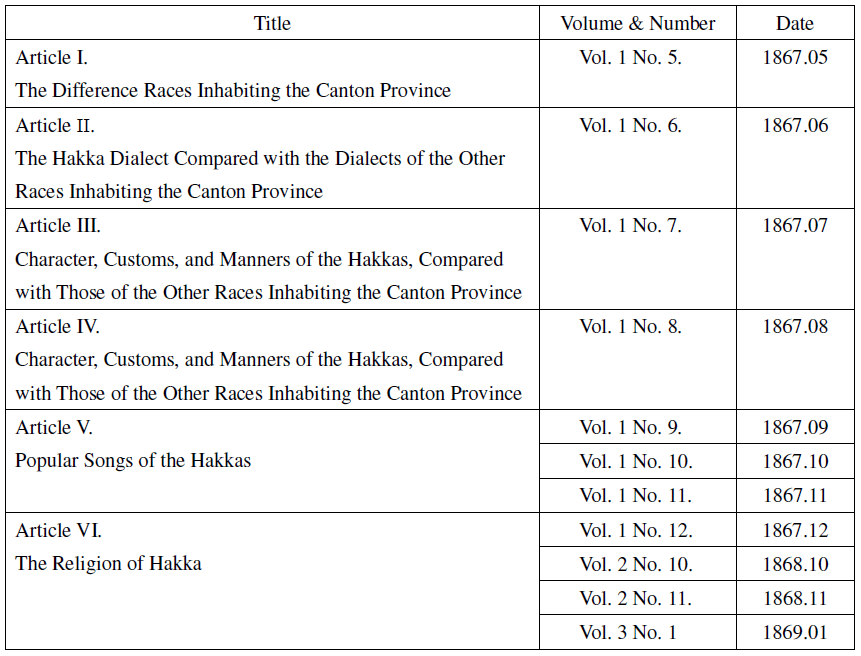
Aside from the social conditions in Guangdong Province, the academic trend among Westerners in China might have also motivated Eitel to write “Ethnographical Sketches of the Hakka Chinese.” As mentioned above, missionaries were expected to provide ethnographic information to facilitate the development of new social sciences. Not only did his colleagues in the LMS publish ethnographic studies, but Notes and Queries on China and Japan was also dedicated to “new and strange” things in the Far East, including history, geography, institutions, and, of course, ethnography. By the nineteenth century, ethnography had become more formal than travel notes in that it had a specific framework by which the traveler could observe and record human culture, so that the results could be indexed and compared by other experts. The questionnaire published by the BAAS in 1852 is such a framework, and its origins can be traced back to the Renaissance, though its direct ancestor was French. However, the science of human culture developed separately in different European countries, and each national tradition focuses on different topics. As a German missionary working in a British society, Eitel was able to adopt both ethnographic traditions when he worked in the field. It brings up an interesting issue: which tradition did Eitel follow in “Ethnographical Sketches of the Hakka Chinese”? To answer this question, a comparative study is required.
In Figure 1, I compare the topics in Eitel’s “Ethnographical Sketches of the Hakka Chinese” and German and British ethnography. British ethnography is represented by “A Manual of Ethnological Inquiry” (MEI), the questionnaire published by the BAAS in 1852. Since MEI was distributed to missionary stations worldwide, it was possible for Eitel to refer to this questionnaire. MEI suggests eleven topics of ethnographic inquiry:
- Physical character
- Language
- Grammar
- Individual and family life
- Buildings and monuments
- Works of art
- Domestic animals
- Government and laws
- Geography and statistics
- Social relations
- Religion, superstitions, etc.
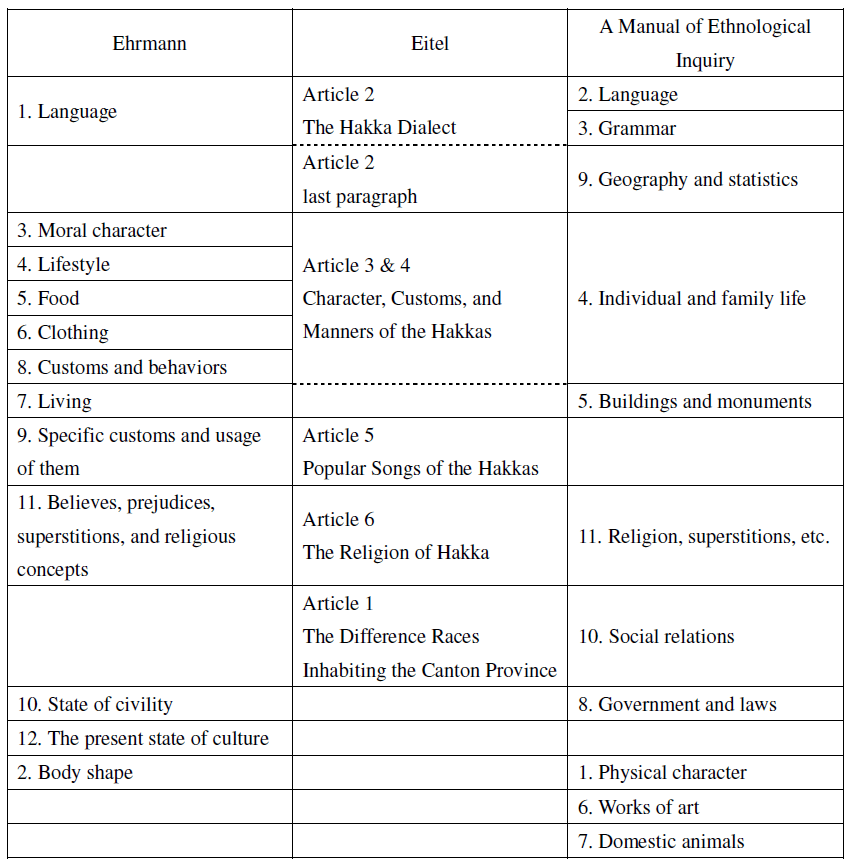
German ethnography is represented by Theophil Friedrich Ehrmann’s “Umriss der Allgemeinen und Besonder Völkerkunde” (Outline of General and Specific Ethnography).[21] Völkerkunde here is translated as “ethnography” in English, for Ehrmann asserted that Ethnographie another name for Völkerkunde.[22] However, if we translate Ehrmann’s terms in the British context, what he outlined in this article are comparative (general) ethnology and descriptive (specific) ethnography. Ehrmann was not a professional academic but an editor of ethnographic journals.[23] He was active in the Rhineland after Schlözer’s proposal of Ethnographie and Völkerkunde. Although he was not engaged in ethnography himself, being an editor allowed him to describe the topics that a German ethnographer would focus on, providing a glance at German ethnography. Most of Ehrmann’s text discussed “general ethnography” and treating “specific (regional) ethnography” as a source of valuable materials to help the comparative study of general ethnography. Even though Ehrmann’s outline preceded MEI for nearly a half-century, both articles provide overviews of their national tradition of ethnography, so they are comparable. Ehrmann listed twelve topics and discussed observational points under each topic. Here is the list:
- Language
- Body shape
- Moral character
- Lifestyle
- Food
- Clothing
- Living
- Customs and behaviors
- Specific customs and usage of them
- State of civility
- Believes, prejudices, superstitions, and religious concepts
- The present state of culture
Comparing Eitel’s topics with Ehrmann’s “Umriss” and the BAAS’s MEI, we can find a significant number of shared topics among all three, as well as some discrepancies. To determine the source of influence, differences are more important than similarities. Language is one of the shared topics, but a close comparison reveals the affinity between Eitel and Ehrmann, and the contrast with MEI. For example, both Ehrmann and MEI suggest observing language, but only Ehrmann emphasized finding relationships between languages and the historical usage of linguistic study. On the other hand, MEI focuses on language documentation. Although documentation is the foundation of historical comparative pursuit in linguistics, MEI seems to reserve it for professional linguists. By contrast, historical linguistics and language classification had already been a legitimate subject in Germany. In Eitel’s Hakka ethnography, Article II, “The Hakka Dialect Compared with the Dialects of the Other Races Inhabiting the Canton Province,” discusses the historical relationship of the three dialects spoken in Guangdong Province. With relatively little evidence, he concludes that Hakka occupies an intermediate position in the historical development between the archaic Cantonese and the innovative Mandarin. Eitel also finds that Hoklo (a dialect of Southern Min) is very different from Hakka and Cantonese, and he points out that some strange features of Hoklo may come from a more archaic form of Chinese.[24] In short, Eitel did not follow the instructions in MEI. Although Eitel’s conclusions do not fully square with the latest knowledge of Chinese historical linguistics, his emphasis on historical linguistics suggests the influence of German ethnography in his work. Other topics also indicate the German influence in Eitel’s ethnography. Ehrmann suggests “specific customs and usage of them” as an ethnographic topic, and Eitel elaborated this topic by translating Hakka popular songs, which he claimed were the most certain indicators of national character.[25] Not all readers appreciated the value of Hakka popular songs, so Eitel had to explain the reasons for documenting these songs in the beginning of the second part.[26] Unfortunately, Eitel translated popular songs into English without preserving the originals, making his “documentation” meaningless in studying Hakka literature. However, this failure also proves that Eitel had no intention of documenting a language as MEI suggested. Thus, with these comparisons, we can conclude that Eitel’s Hakka ethnography was mostly influenced by German ethnography.
Eitel’s Missionary Ethnography
As a product of the German Late Enlightenment, ethnography is generally a secular discipline in which religion does not occupy an important role. However, the discipline’s secular character does not prevent ethnographers from connecting the description of culture to religious objectives. By studying the culture of its target audience, missionary ethnography not only describes that culture but finds peaceful methods by which to preach Christianity. Eitel’s “Ethnographical Sketches of the Hakka Chinese” is such an integration of ethnography and evangelism, and this intention is best reflected in his description of Hakka popular songs and the Hakka religion. Eitel spent three issues introducing and translating Hakka popular songs, but readers challenged him as soon as he published the first part, which only cited a pair of responsorium sung between Hakka men and women. Eitel had already argued that popular songs were “the surest index of the national character” and explained the value of popular songs in the first part.[27] In the second part, he further defended his position by claiming the value of studying popular songs in evangelism. He began by arguing that popular songs represented the standard of the colloquial language, which was understood by both learned and unlearned people. Eitel believed that preaching in colloquial language (rather than reading out the written language taught by Chinese teachers) could reach a larger audience and facilitate missionary work. Following this rationale, Eitel planned to use translated Christian songs to replace popular songs, which Eitel felt contained many improprieties. However, the hymns translated into Classical Chinese were unintelligible to the uneducated majority of the population. In order to provide native converts with Christian songs, it was necessary to study the native songs and then produce Western poetry “clad in the same homely dress.”[28] Although the issue of style in translation would last decades among China-based missionaries, Eitel’s strategy in the late 1860s was quite naturally Protestant in that he valued the vernacular and doubted the usefulness of the cross-regional classical language. Unfortunately, we have no information about how Eitel pursued his vision of creating Christian songs with native form, so we are unable to evaluate his achievement.
Studying the Hakka religious system is another approach of Eitel’s missionary ethnography. In this subject, Eitel abandoned the study of written classics because he believed it was impossible to find a strict logic in Asiatic religions. His criticism of this inconsistency was that “their principle is to have no principle.”[29] Therefore, Eitel chose to observe the practice of the Hakka popular religion directly. Eitel repeatedly distinguished the religious practices of the Hakka from neighboring peoples, the Punti and the Hoklo, and described how the Hakka distanced themselves from idolatry on religious occasions. For example, according to Eitel, the Hakka refused the intervention of Buddhist and Taoist priests in the ancestral ceremony, their most important rite. Instead of priests, the head of the family led the ceremony. Eitel claimed this refusal was specific to the Hakka.[30] In the fourth part of “The Religion of the Hakkas,” Eitel described the worship of lares rustici (guardian of countryside) and how elders of the community led this ceremony.[31] By mentioning the role of head of family in religious occasions, Eitel seemed to hint at the possibility of transplanting the Presbyterian polity to the Hakka Christian family or community, even though he did not explicitly state this idea. Moreover, Hakka beliefs concerning the soul’s immortality and resurrection, though shaped in large part by “superstitions” from Taoism, suggest there is common ground between Hakka popular religion and Christianity.[32] The high possibility of converting the Hakka to Christianity is further supported by what Eitel claimed was their inclination toward monotheism. Eitel said the Hakka have only “one supreme God” who is “the God above all gods.”[33] All subordinate gods have to report to the supreme God on the 24th day of the 12th month. The date looks coinciding with Christmas Eve, regardless the difference between solar and lunar calendars. Eitel argued that the respect for this supreme personage indicated that the Hakka had monotheistic beliefs. The Supreme Being is so exalted and so high that the Hakka believe no offering could be worthy of him and dare not to worship Him. Aside from this supreme god, the Hakka worship many other gods, but Eitel did not think this polytheistic practice negated their native monotheism. He explains this idea through the metaphor of emperor and mandarins and says that “the obeisance made to a mandarin is not in antagonism to the allegiance due to the person of the emperor.”[34] The name of the supreme God is “the pearly Emperor and Supreme Ruler” (Yùhuán Shàngdì 玉皇上帝). His relation to the “heavenly grand-father” (Tian-a-gong 天亞公) is ambivalent. Sometimes the Hakka consider them two different names for the supreme God, but sometimes they place “heaven” above “the pearly Emperor and Supreme Ruler.” Eitel treated this inconsistency as a common characteristic of Eastern religions. In his opinion, it did not change the fact that the Hakka religion was essentially monotheistic.[35]
Eitel’s ethnography always maintained a descriptive tone, and in “Ethnographical Sketches of the Hakka Chinese” he rarely connected his description explicitly to evangelism. Instead, Eitel addressed evangelical issues by implication. By emphasizing the native monotheism, as mentioned above, he implied the possibility of replacing “the pearly Emperor and Supreme Ruler” (Yùhuán Shàngdì) with the Christian God. His understanding of Hakka monotheism was further elaborated in his comments on “the Term Question,” that is, how to translate “God” into Chinese. In a short note published in 1876, Eitel’s statement addressing “the Term Question” was cited by J. S. Burdon. In the cited statement, Eitel argued that “Shàngdì 上帝” was the proper translation for “God” because “Shàngdì” was “a relic of ancient Monotheism which obtained in China before either Confucianism, Buddhism, or Taouism misused that term.” Eitel referred to the Jesuits who defended the use of the classical term to support his argument and criticized the “ignorant Dominicans” who misled the Vatican into translating God to “Tiānzhǔ天主,” which, Eitel argued, implies the existence of an earthly counterpart and is thus polytheistic. He also criticized his contemporary American missionaries (especially the Methodists in Fuzhou) who used “shén神” to translate “God” by noting that “bài shén 拜神” was an idiomatic term referring to idolatrous worship. Eitel claimed that nearly all English, all German, and some American missionaries used “Shàngdì” to refer to God, though Burdon highly doubted this. Eitel also indicated that the use of the terms “Shàngdì” for the true God and “shén” for other gods would be proposed to the general conference of Protestant missionaries held in 1877. [36] Although Eitel did not state where he found the term “Shàngdì” in the 1876 statement, in his Hakka ethnography he states that the Hakka recognize “the pearly Emperor and Supreme Ruler” as the Supreme God of the universe, and thus “Shàngdì” is the (Hakka) Chinese equivalent of the Christian God. However, Eitel’s knowledge of the Jesuits is obviously imperfect because, since the late sixteenth century, Matteo Ricci, one of the most famous China-based Jesuits in contemporary and history, had used “Tiānzhǔ” to translate “God”, and it was Ricci who decided to translate “Deus (God)” to “Tiānzhǔ.” Despite Eitel’s imperfect knowledge of the missionary history of Christianity in China, Eitel’s praise of the learned Jesuits echoes his missionary ethnography and knowledge of Chinese culture. Both Eitel and the seventeenth-century Jesuits studied the culture of their target audience and used this study to assist missionary works. Therefore, their ethnographic works are missionary ethnography.
Eitel’s Hakka ethnography also left a significant legacy in Hakka studies by initiating the canonization of the Hakka migration history. The migration history, which claims that the Hakka are descendants of the people from “Zhōngyuán中原” (today’s Henan Province and vicinity) in northern China, is very important in the formation of the Hakka identity. Eitel’s statements that the Hakka are “thorough-bred Chinese” and that their religion retains “a relic of ancient Monotheism” imply that the Hakka preserved valuable legacies from ancient China. In the context of “Ethnographical Sketches of the Hakka Chinese,” to declare a connection with ancient China is a defensive strategy against discrimination toward the Hakka. Eitel did not elaborate on this issue in his ethnographic sketches but left it to another treatise, “An Outline History of the Hakkas,” published in 1873. According to Eitel’s note, this treatise was written in the late 1860s as a supplement to the ethnographic sketches, so it can be considered a part of Eitel’s Hakka ethnography.[37] In this historical outline, Eitel developed the connection between the Hakka and its ancient homeland. He referred to Hakka genealogies and family registers carefully preserved by every clan to construct the history of the Hakka. Eitel said that most genealogical records state that the given family’s ancestors lived in the late Zhou Dynasty (ca. third century BCE) near the south and southwest parts of today’s Shantong 山東Province, which are on the outer edges of Zhōngyuán. In the Qin Dynasty (late third century BCE), the tyrannical emperor oppressed the Hakka and initiated their long migration toward southern China. Around the thirteenth and fourteenth centuries, the Hakka reached the eastern edge of Guangdong Province and there found a pleasant place to live. In the subsequent centuries up until Eitel’s time, the Hakka expanded their territory in the province and encountered other ethnic groups, especially the Cantonese-speaking Punti, leading to numerous bloody conflicts.[38] Eitel’s historical outline ends with a note from W. F. Mayer of the British consulate concerning the Hakka-Punti conflict in the 1860s.
As a student of the Tübingen School, Eitel treated historical materials as essential in understanding the ancient past. Eitel’s reference to genealogies is quite standard in his training. However, Eitel trusted the genealogies too much and believed these family records were all true. Recent studies show that genealogy started in the sixteenth century. People used genealogy to consolidate clan power in order to pursue economic and political agendas. Therefore, modern scholars tend to avoid reading genealogies literally; instead, they interpret their symbolic meanings. Unfortunately, Eitel’s uncritical reading of genealogy became popular in Hakka studies. The migration history supports the idea that the Hakka are descendants of noble clans from the core region of Chinese civilization. This idea not only provided legitimacy to counter discrimination from non-Hakka peoples but also united Hakka-speaking people and led them to distinguish themselves from other peoples, helping them form a strong Hakka identity since the twentieth century. In the 1930s, nearly sixty years after the publication of Eitel’s Hakka history and ethnography, Lo Hsiang-lin further elaborated the migration history that Eitel initiated. Lo Hsiang-lin’s version of Hakka migration history was seminal in the twentieth century, and identification with “Zhōngyuán” became a core belief in the modern Hakka identity. Numerous instances can be cited, but I will mention only one case here. One of the most influential Hakka magazines in Taiwan is titled Zhōngyuán Zázhì中原雜誌, and its primary contribution was to promote Hakka migration history in Taiwan. Today most people know only Lo Hsiang-lin but not Eitel. However, I must reiterate that it was Eitel who initiated the construction of the Hakka migration theory in the late 1860s, even though the latest studies have discredited this popular theory.
Concluding Remarks
Missionaries played an important role in the history of ethnography. They went into the field before professional scholars and returned with their observations to enrich further scholarly investigations. Using the analogy of missionary linguistics, this paper explores the possibility of defining missionary ethnography as a subject of future research. The scope of missionary ethnography is undoubtedly worldwide, but I am limiting my study to the Chinese realm, with which I am more familiar. In fact, missionary ethnography in the Chinese realm alone is quite a large field to explore. Henri Courdier’s Bibliotheca Sinica is an indispensable source, and the survey should, at a minimum, cover not only the section “Ethnography and Anthropology” but also “General Works” and “Religion.” Surveying Bibliotheca Sinica is not the objective of this paper. Instead, I review Eitel’s “Ethnographical Sketches of the Hakka Chinese” and “An Outline History of the Hakkas” from the perspective of missionary ethnography. Eitel’s works bridge the German ethnography that flourished in the German Late Enlightenment and the Hakka studies that developed with the formation of the Hakka identity. By studying Eitel’s academic background and missionary career, this paper identifies the intellectual roots of Eitel’s missionary ethnography, analyzes how Eitel applied ethnography in evangelism, and finally, clarifies his legacy in Hakka studies. I believe this approach is a viable method by which to study and analyze missionary ethnography in general. Further studies on other missionaries’ ethnographic works will weave a network across time and space in this history of knowledge.
List of References
Burdon, J. S. The Chinese Term for God: A Letter to the Protestant Missionaries of China. Hong Kong: De Souze and Co., 1877.
Chalmers, John. The Origin of the Chinese: An Attempt to Trace the Connection of the Chinese with the Western Nations in Their Religion, Superstitions, Arts, Languages, and Traditions. Hong Kong: De Souza & Co., 1866.
Cull, Richard. “Sketch of the Recent Progress of Ethnology." Journal of the Ethnological Society of London 4 (1856): 104-19.
Doolittle, Justus. Social Life of the Chinese [in English]. 2 vols. Vol. 1-2, New York: Harper & Brothers, 1865.
Ehrmann, Theophil Friedrich. “Umriss Der Allgemeinen Und Besonder VöLkerkunde." In Allgemeines Archiv Für Ethnographie Und Linguistik, edited by F. J. Bertuch and J. S. Vater, 9-25. Weimer: Landes-Industrie-Comptoir, 1808.
Eitel, Ernst Johannes. A Chinese Dictionary in the Cantonese Dialect. London: Trübner & Co., 1877.
———. “Ethnographical Sketches of the Hakka Chinese, Article 1-6." Notes and queries: on China and Japan 1.5-3.1 (1867-1869).
———. “Ethnographical Sketches of the Hakka Chinese: Character, Customs, and Manners of the Hakkas, Compared with Those of the Other Races Inhabiting the Canton Province." Notes and Queries on China and Japan 1, no. 7 (1867): 81-83.
———. “Ethnographical Sketches of the Hakka Chinese: Character, Customs, and Manners of the Hakkas, Compared with Those of the Other Races Inhabiting the Canton Province." Notes and Queries on China and Japan 1, no. 8 (1867): 97-99.
———. “Ethnographical Sketches of the Hakka Chinese: Popular Songs of the Hakkas." Notes and Queries on China and Japan 1, no. 9 (1867): 113-14.
———. “Ethnographical Sketches of the Hakka Chinese: Popular Songs of the Hakkas (Continued)." Notes and Queries on China and Japan 1, no. 10 (1867): 129-30.
———. “Ethnographical Sketches of the Hakka Chinese: Popular Songs of the Hakkas (Continued)." Notes and Queries on China and Japan 1, no. 11 (1867): 145-46.
———. “Ethnographical Sketches of the Hakka Chinese: The Difference Races Inhabiting the Canton Province." Notes and Queries on China and Japan 1, no. 5 (1867): 49-50.
———. “Ethnographical Sketches of the Hakka Chinese: The Difference Races Inhabiting the Canton Province." Notes and Queries on China and Japan 1, no. 5 (1867): 49-50.
———. “Ethnographical Sketches of the Hakka Chinese: The Hakka Dialect Compared with the Dialects of the Other Races Inhabiting the Canton Province." Notes and Queries on China and Japan 1, no. 6 (1867): 65-67.
———. “Ethnographical Sketches of the Hakka Chinese: The Religion of Hakka." Notes and Queries on China and Japan 1, no. 12 (1867): 161-63.
———. “Ethnographical Sketches of the Hakka Chinese: The Religion of Hakka (Continued)." Notes and Queries on China and Japan 2, no. 11 (1868): 167-69.
———. “Ethnographical Sketches of the Hakka Chinese: The Religion of Hakka (Continued)." Notes and Queries on China and Japan 3, no. 1 (1869): 1-3.
———. “Ethnographical Sketches of the Hakka Chinese: The Religion of Hakka (Continued)." Notes and Queries on China and Japan 2, no. 10 (1868): 145-47.
———. Europe in China: The History of Hongkong from the Beginning to the Year 1882. London: Luzac & Company, 1895.
———. Hand-Book of Chinese Buddhism. London: Trübner & Co., 1870.
———. “An Outline History of the Hakkas." The China Review, or Notes and Queries on the Far East 2, no. 3 (1873): 160-64.
Hamberg, Theodore. The Visions of Hung-Siu-Tshuen, and Origin of the Kwang-Si Insurrection. Hong Kong: The China Mail Office, 1854.
Hodgen, Margaret T. Early Anthropology in the Sixteenth and Seventeenth Centuries [in English]. Philadelphia: University of Pennsylvania Press, 1964.
Ostler, Nicholas. “The Social Roots of Missionary Linguistics." In Missionary Linguistics, edited by Otto Zwartjes and Even Hovdhaugen, 33-46. Amsterdam: John Benjamins, 2004.
Schlatter, Whlhelm. Zhēnguāng Zhào Kèjiā: Bāsèchàhuì Zǎoqí Lái Huá Xuānjiào Jiǎnshǐ 1839-1915 真光照客家 : 巴色差會早期來華宣教簡史:1839-1915. Translated by Richard Deutsch and Chau Tin Wo. Hong Kong: Tsung Tsin Mission of Hong Kong, 2008.
The British Association for the Advancement of Science. “A Manual of Ethnological Inquiry." Journal of the Ethnological Society of London 3, no. 1854 (1854): 193-208.
Toy, C. H. “The Tübingen School." The Baptist Quarterly 3 (1869): 210-34.
Vermeulen, Han F. Before Boas: The Genesis of Ethnography and Ethnology in the German Enlightenment. Lincoln, Nebraska: University of Nebraska Press, 2015.
Zwartjes, Otto, and Even Hovdhaugen. “Introduction." In Missionary Linguistics, edited by Otto Zwartjes and Even Hovdhaugen, 1-3. Amsterdam: John Benjamins, 2004.
[1] Han F. Vermeulen, Before Boas: The Genesis of Ethnography and Ethnology in the German Enlightenment (Lincoln, Nebraska: University of Nebraska Press, 2015), 131-57.
[2] Ibid., 104-12.
[3] The British Association for the Advancement of Science, “A Manual of Ethnological Inquiry," Journal of the Ethnological Society of London 3, no. 1854 (1854): 193-208.
[4] Richard Cull, “Sketch of the recent progress of ethnology," Journal of the Ethnological Society of London 4(1856): 119.
[5] Otto Zwartjes and Even Hovdhaugen, “Introduction," in Missionary Linguistics, ed. Otto Zwartjes and Even Hovdhaugen (Amsterdam: John Benjamins, 2004), 1-3.
[6] Nicholas Ostler, “The Social Roots of Missionary Linguistics," in Missionary Linguistics, ed. Otto Zwartjes and Even Hovdhaugen (Amsterdam: John Benjamins, 2004), 41.
[7] Justus Doolittle, Social life of the Chinese, 2 vols., vol. 1-2 (New York: Harper & Brothers, 1865).
[8] John Chalmers, The origin of the Chinese: an attempt to trace the connection of the Chinese with the western nations in their religion, superstitions, arts, languages, and traditions (Hong Kong: De Souza & Co., 1866). This work was mentioned in the LMS archive as “The Ethnology of China”. London Missionary Society, “Legge, J, and Chalmers. J Re application of Mr. Eitel. His reason to leave Basel Mission” June 9 1865. The School of Oriental and African Studies, University of London, London: Council for World Mission/London Missionary Society/South China Incoming Correspondence/Box 6/Folder 4/Jacket D, 27.
[9] Universitätarchiv Tübingen – Signatur: 131/20b,26
[10] Universitätarchiv Tübingen – Signatur: 42/4 No. 33
[11] C. H. Toy, “The Tübingen School," The Baptist Quarterly 3(1869): 212-17.
[12] Vermeulen, Before Boas: The Genesis of Ethnography and Ethnology in the German Enlightenment: 219-52.
[13] Whlhelm Schlatter, Zhēnguāng Zhào Kèjiā: Bāsèchàhuì Zǎoqí Lái Huá xuānjiào Jiǎnshǐ 1839-1915 真光照客家 : 巴色差會早期來華宣教簡史:1839-1915, trans. Richard Deutsch and Chau Tin Wo (Hong Kong: Tsung Tsin Mission of Hong Kong, 2008), 70-71.
[14] London Missionary Society, “Legge, J, and Chalmers. J Re application of Mr. Eitel. His reason to leave Basel Mission” June 9 1865. The School of Oriental and African Studies, University of London, London: Council for World Mission/London Missionary Society/South China Incoming Correspondence/Box 6/Folder 4/Jacket C, 8;
London Missionary Society, “Eitel, E. offers his service to L.M.S.” May 25 and June 2 1865. The School of Oriental and African Studies, University of London, London: Council for World Mission/London Missionary Society/South China Incoming Correspondence/Box 6/Folder 4/Jacket C, 7
[15] Ernst Johannes Eitel, Europe in China: The History of Hongkong from the Beginning to the Year 1882 (London: Luzac & Company, 1895).
[16] Ernst Johannes Eitel, Hand-book of Chinese Buddhism (London: Trübner & Co., 1870).
[17] Universitätarchiv Tübingen – Signatur: 131/20b,26
[18] Ernst Johannes Eitel, A Chinese Dictionary in the Cantonese Dialect (London: Trübner & Co., 1877).
[19] Theodore Hamberg, The Visions of Hung-Siu-tshuen, and Origin of the Kwang-si Insurrection (Hong Kong: The China Mail Office, 1854), 4.
[20] Ernst Johannes Eitel, “Ethnographical Sketches of the Hakka Chinese: The Hakka Dialect Compared with the Dialects of the Other Races Inhabiting the Canton Province," Notes and Queries on China and Japan 1, no. 6 (1867): 65.
[21] Theophil Friedrich Ehrmann, “Umriss der Allgemeinen und Besonder Völkerkunde," in Allgemeines archiv für ethnographie und linguistik, ed. F. J. Bertuch and J. S. Vater (Weimer: Landes-Industrie-Comptoir, 1808), 9-25.
[22] Ibid., 9.
[23] Vermeulen, Before Boas: The Genesis of Ethnography and Ethnology in the German Enlightenment: 336-37, 44-47.
[24] Eitel, “Ethnographical Sketches of the Hakka Chinese: The Hakka Dialect Compared with the Dialects of the Other Races Inhabiting the Canton Province," 67.
[25] Ernst Johannes Eitel, “Ethnographical Sketches of the Hakka Chinese: Popular Songs of the Hakkas," Notes and Queries on China and Japan 1, no. 9 (1867): 113-14.
[26] Ernst Johannes Eitel, “Ethnographical Sketches of the Hakka Chinese: Popular Songs of the Hakkas (Continued)," Notes and Queries on China and Japan 1, no. 10 (1867): 129.
[27] Eitel, “Ethnographical Sketches of the Hakka Chinese: Popular Songs of the Hakkas," 113.
[28] Eitel, “Ethnographical Sketches of the Hakka Chinese: Popular Songs of the Hakkas (Continued)," 129.
[29] Ernst Johannes Eitel, “Ethnographical Sketches of the Hakka Chinese: The Religion of Hakka," Notes and Queries on China and Japan 1, no. 12 (1867): 161.
[30] Ernst Johannes Eitel, “Ethnographical Sketches of the Hakka Chinese: The Religion of Hakka (Continued)," Notes and Queries on China and Japan 2, no. 10 (1868): 145.
[31] Ernst Johannes Eitel, “Ethnographical Sketches of the Hakka Chinese: The Religion of Hakka (Continued)," Notes and Queries on China and Japan 3, no. 1 (1869): 1.
[32] Eitel, “Ethnographical Sketches of the Hakka Chinese: The Religion of Hakka (Continued)," 146.
[33] Eitel, “Ethnographical Sketches of the Hakka Chinese: The Religion of Hakka (Continued)," 168.
[34] Ibid.
[35] Ibid., 169.
[36] J. S. Burdon, The Chinese Term for God: A Letter to the Protestant Missionaries of China (Hong Kong: De Souze and Co., 1877), 3-4.
[37] Ernst Johannes Eitel, “An Outline History of the Hakkas," The China Review, or Notes and Queries on the Far East 2, no. 3 (1873): 160.
[38] Ibid., 161-62.
貓只記得報告那天倫敦超熱,貓緊張得要死,講得結結巴巴。最後Q&A才回復正常表現。
 Kleine Schriften 拙搞收集